YouTube Thumbnail Design Services in 2026: What You Are Buying and What It Costs
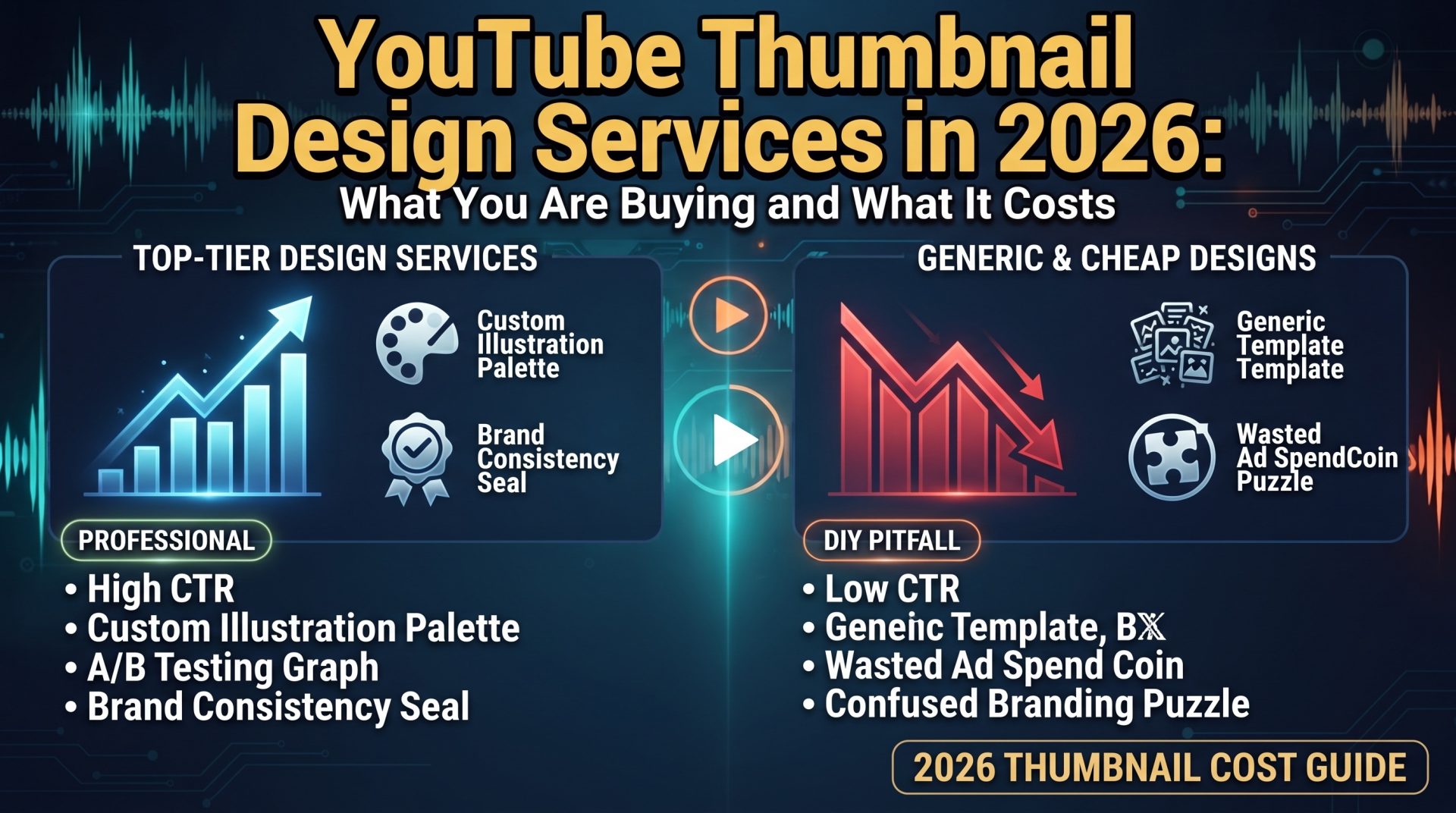
You can make the best video on YouTube and still fail, purely because the thumbnail said "skip". The thumbnail is the one asset that decides whether your distribution engine ever runs, and it is routinely treated as an afterthought — an auto-generated frame of a face mid-word, a frame of YouTube's UI, a blurry screenshot. Professional thumbnail design exists precisely to close that gap: to move the choice from "maybe" to "click". This guide explains what a thumbnail designer actually does for your channel, what the work costs in 2026, and how to test designs so click-through rate keeps improving instead of relying on luck.
Why Thumbnails Matter as Much as Content
YouTube recommends videos one thumbnail at a time. A viewer glancing down a sidebar decides in a fraction of a second whether your content merits them, using nothing but a small image and a title. A well-designed thumbnail improves click-through across the most competitive real estate on the internet, and CTR feeds the algorithm: more clicks signal relevance, which wins more impressions. Thumbnail design is not decoration; it is the front door of your entire channel. Channels that treat it as such consistently outperform those that regard it as a chore — measured not in aesthetics but in views.
What a Professional Thumbnail Designer Does
Composition and hierarchy
The designer decides what the eye sees first: one dominant element, usually a face with a readable expression, then the subject, then the text — three beats in the right order. Amateur thumbnails cram everything in, and crammed thumbnails read as noise at 50 pixels wide.
Contrast and lighting
Brightness, saturation and edge separation make the thumbnail survive both a dark mobile screen and a cluttered recommended feed. A designer tunes these deliberately; a crop does not.
Typography that reads instantly
Three to five words, in a display font, sized for the smallest screen you publish to. Thumbnail text is a headline, not a caption — and it must work without sacrificing the face, which is the part that carries emotion.
Series consistency
Recurring formats — same layout, same styling, same call-outs — let viewers recognise your brand before they read anything. That recognisability compounds; your next video starts with familiarity instead of from zero.
What It Costs in 2026
| Service | Typical cost | Who it fits |
|---|---|---|
| Freelancer per thumbnail | $10 – $50 each | Low volume, casual channels |
| Professional designer | $50 – $150 each | Serious uploaders wanting quality |
| Monthly design package | $300 – $1,500/month | Daily/weekly channels with systems |
| Full package (design + strategy + testing) | $1,500 – $5,000/month | Channels where CTR drives revenue |
The price difference is not the software — it is the decisions behind the image. A designer who asks about your audience, your rivals and your goals before opening a file is worth a multiple of one who merely delivers call-outs.
The Rules of Effective Thumbnails
- One focal element. Two faces dilute; three faces confuse.
- Text as a hook, not an explanation — three to five words tops.
- High contrast and distinct colour separation from the YouTube feed.
- Emotion over neutrality: an expressive frame beats a neutral one.
- Design for the smallest size first, then enjoy the detail on desktop.
- Test, always: CTR is the referee, and taste has a poor record against data.
Testing Thumbnails Like an Editor
Professional channels do not trust vibes; they run split tests. YouTube's built-in testing (and external tools) let you upload two or three designs, let the algorithm split the traffic, and keep the winner by measured CTR. Run tests on the high-stakes uploads — the ones with big budgets behind them — and let the platform's audience tell you which message, expression or colour wins. Over a few months this practice quietly lifts channel-wide CTR by a meaningful margin, which is the single most durable advantage your distribution can have. Document what wins, because the learnings carry into the next series.
DIY vs. Hiring a Designer
Yes, you can design your own thumbnails with good templates and a steady discipline — many successful solo channels do exactly that. The threshold for hiring is simply volume and value: when every upload's thumbnail directly moves income and you are publishing more than a few videos a month, a professional's time frees yours for scripts and edits, and their consistency improves your CTR. The hybrid path is popular: a designer builds a reusable system — your template set, your palette, your type — and the daily uploads are produced quickly inside it. That system costs a fraction of bespoke-per-video work and yields most of its benefit.
Frequently Asked Questions
Do thumbnails really move the algorithm?
Yes. CTR is a direct relevance signal; a better thumbnail raises impressions per video over time, which is the definition of stronger distribution.
Should every video have a designer thumbnail?
Every scheduled upload should have a deliberate thumbnail designed under your system — whether made by you or a designer. The cost is in the discipline, not the software.
How many versions should I test?
Two is the practical minimum; three when the video is high stakes. Keep the winner's pattern in your design system and retire what loses.
It also pays to treat thumbnails as part of your production pipeline, not a post-production parcel. In a professional workflow, the thumbnail is briefed at the same time as the script — the hook that opens the video is the same hook the thumbnail promises, so the viewer gets precisely what the click sold. Channels that align thumbnail, title and opening seconds earn trust with every click, and trust is the invisible factor behind repeat viewing and subscriptions. Hand your designer the title and the hook line before the video is even edited, and give them room to propose a visual that makes that promise glanceable. When design, script and thumbnail pull in the same direction, retention rises alongside click-through, and both feed the algorithm the way you actually want it fed.
Thumbnails are a system, not an event. Build the system, test every claim, and let CTR — not taste — make the final call on what your audience deserves.