
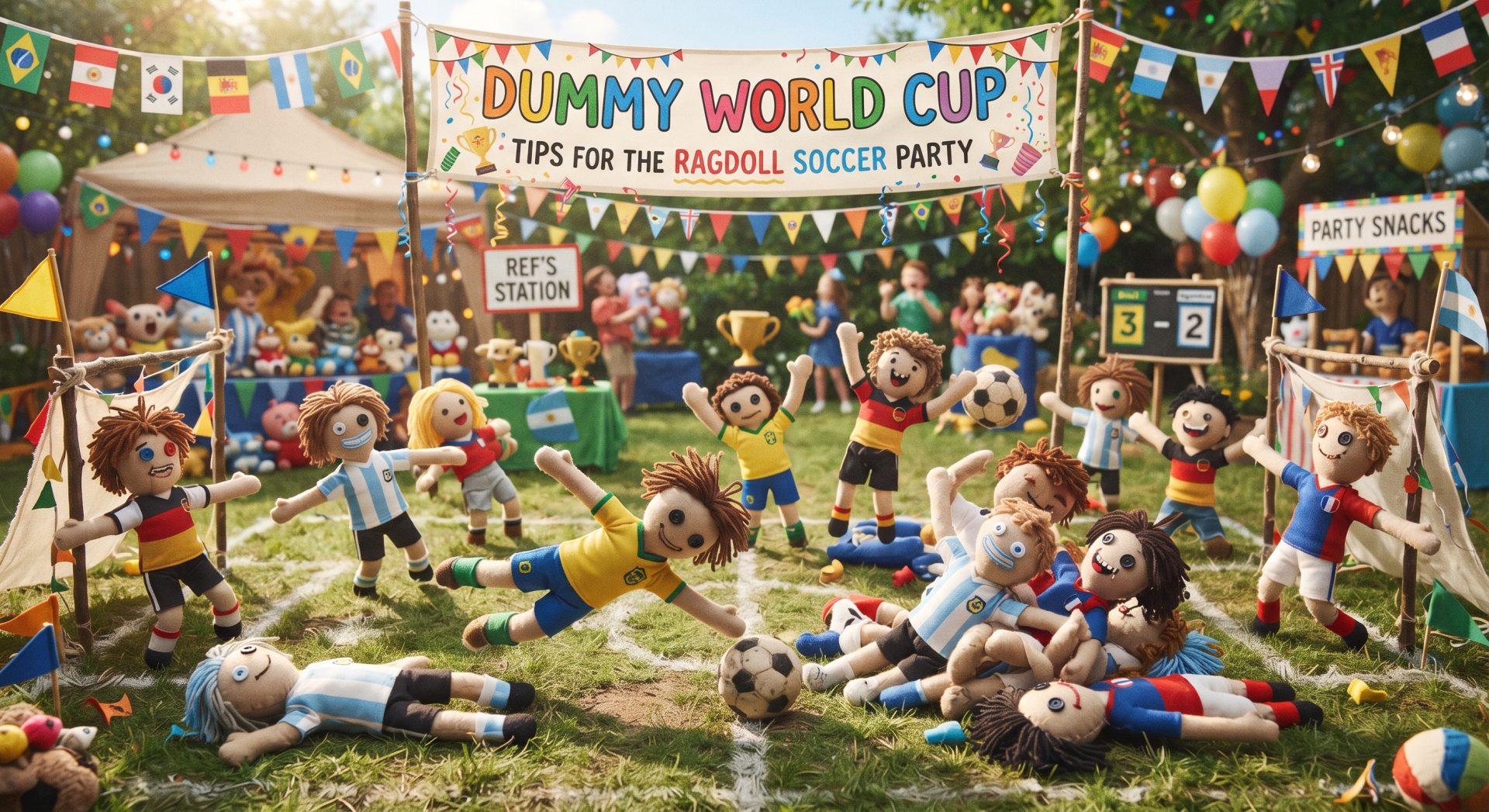
Few browser games mix comedy and competition as brilliantly as dummy world cup. It takes the classic soccer formula and rebuilds it around floppy, boneless puppet athletes that tumble, flail, and bounce across the pitch in ways that physics engines were never meant to allow. The result is a tournament experience that feels less like a serious match and more like a chaotic puppet show where anything can happen on every single kick.
What makes dummy world cup addictive is the unpredictable character of the movement itself. Your puppet player is not a polished athlete. It is a cloth doll with limbs that bend in unnatural directions, a head that lags behind its body, and a center of gravity that changes with every step. When you sprint toward the ball, your entire body leans forward and you might fall flat on your face. When you kick, your leg swings in a lazy arc and the ball might shoot in an entirely unexpected direction. This slapstick physics system turns routine plays into comedy and makes lucky goals feel absolutely glorious.
Why chaotic physics make the game so entertaining
The core hook of dummy world cup is its dedication to absurd, unpolished movement. Unlike polished sports simulators that reward precise timing and perfect angles, this game rewards courage, speed, and a willingness to throw your puppet at the ball without worrying about the consequences. The animations are deliberately loose, and each character reacts to contact with the ball, the ground, and other players in ways that are only partially predictable. That unpredictability is the comedy engine that keeps players coming back for one more match.
Every confrontation becomes a physics puzzle. Two puppets racing for the same loose ball will collapse into a tangled pile of limbs, and the ball can squirt out in any direction. A powerful shot from the edge of the area might send the keeper flying backward while the ball dribbles gently over the line. These moments are not bugs. They are the whole point of the experience, and seasoned players learn to plan around them rather than fight against them.
Reading the flail
Successful players in dummy world cup learn to read the flail. Because limb movement is delayed and exaggerated, every action has a visible wind-up. A player who starts a slide tackle early will glide much farther than the slide bar suggests, while a player who kicks too late will watch their puppet spin in place and send the ball nowhere useful. Timing becomes a matter of anticipation, and the best players learn to commit to a movement half a second before they actually want to connect.
Teamwork and positioning in tournament matches
While solo play is fun, the tournament mode in dummy world cup shines when you pay attention to positioning. Even with floppy physics, a well-organized team creates more chances than a group of players chasing the ball together. Keeping one puppet near the opposition goal, one in midfield, and one tracking back gives you outlets on both sides of the pitch and stops the whole team from clustering into a single tangled pile.
Defending benefits from the same logic. A dedicated defender should hold a line between the ball and the goal rather than diving into every tackle. Because catches are unreliable and keepers move slowly, the defender who simply stays in the way and lets the attacker trip over their puppet is often the most effective player on the field. Positioning beats aggression more often than you might expect.
The striker’s job
Strikers in dummy world cup have the most thankless job. They must sprint into space, hold position near the box, and hope that the ball arrives at a reasonable height. Because passes curl unpredictably, a good striker reads the flight of the ball and adjusts the puppet’s body early. Diving headers are spectacular but rarely aimed, so most goals come from shots that keep low and slip past the keeper’s slow reactions.
Controls, modes, and match flow
The controls are reassuringly simple. One set of buttons handles movement, another handles kicking, and a dedicated action button triggers the slide or the header depending on context. New players can reach the kickoff of their first match within seconds, but mastering the delayed reaction times of the puppet body takes several games. The learning curve is gentle because the goal is fun first and precision second.
Several modes keep the experience fresh. Quick matches give you a single game against an AI team, while the tournament bracket strings together a series of matches with increasing difficulty. There are also penalty shootouts, which become a hilarious battle of nerves as both the kicker and the keeper flail toward the ball. Each mode feeds into the same chaotic logic, so skills learned in one transfer neatly to the others.
Match length and flow
Matches are short by design. With a tight match clock and quick restarts, most games end within a few minutes, which makes dummy world cup ideal for a quick break or a long evening of tournament runs. Restarts happen almost instantly, keeping the momentum high even after a comical own goal. That fast pace is a big reason the game is so easy to pick up again and again.
Why the ragdoll presentation matters
Presentation is the final layer of the charm. The puppet characters wobble when they walk, sprawl when they fall, and freeze dramatically at the end of a big collision. Stadiums are bright and playful, with simple stands and bold colors that keep the focus on the action. The sound effects add to the comedy with thuds, squeaks, and the occasional whistle that punctuates the chaos.
This visual identity does something important. It tells the player not to take the game too seriously. In many sports games, a frustrating loss feels like a personal failure. In dummy world cup, a frustrating loss is usually a hilarious one because the replay shows a puppet twisting through the air in slow motion before landing on its face. The tone transforms failure into entertainment, and that is a rare quality in a competitive game.
Tips for scoring more often and defending better
- Commit to your kicks early and follow through, because the delayed animation punishes hesitation.
- Keep one puppet back at all times to give your keeper a second line of defense.
- Pass across the face of the goal rather than shooting from tight angles, since keepers are slow to adjust.
- Use the slide tackle as a speed tool to reach loose balls faster, not just as a defensive move.
- Stay close to the ball when defending so the attacker has to trip over you to score.
- Win the midfield battle by keeping your third puppet always between the ball and your own goal.
Anyone who spends a little time with the game will develop their own list of tricks, but the fundamentals above will carry new players through the early rounds of any tournament. Consistent positioning and committed movement outperform raw luck more often than newcomers expect.
How to get the most out of a tournament run
Tournament runs reward patience. The opening fixture is usually forgiving, which gives you time to warm up and adjust to the physics. Later fixtures demand a sharper game plan, and that is where the positioning habits from the earlier matches start to pay off. Set aside the urge to chase every loose ball and trust your defenders to hold the line.
Pay attention to the strength of your opponents in the draw. Some teams push high and attack constantly, which leaves space behind their defense for quick counters. Others park the bus and force you to break them down slowly. Reading these styles and adjusting your formation between matches is a skill that separates tournament winners from early exits.
Frequently asked questions
Do I need to download dummy world cup to play it?
No. The game runs directly in the browser, which means there is no download and no installation step. As long as your browser is reasonably modern, you can go from the menu to a match in seconds. Its light footprint makes it a good choice for low-end machines and quick gaming sessions.
Is dummy world cup only a single-player experience?
The core experience is single-player against AI opponents, but the format is designed so that matches can also be shared and replayed. Because each match is short and every goal is chaotic, grabbing a highlight clip and sending it to a friend is half the fun. The game works well as a party title when players take turns on one machine.
Why do the characters move so awkwardly?
That awkwardness is the entire identity of the game. It deliberately recreates a ragdoll puppet with loose joints and delayed reactions, and the physics engine exaggerates every stumble and collision. The developers traded realism for comedy, and the result is a game where a perfect header and a perfect faceplant have equal value as entertainment.
What devices can run dummy world cup smoothly?
Almost anything with a browser. The game keeps its visual demands modest, so even an older laptop or a mid-range phone runs it without crawling. Obviously, a faster machine gives smoother frame rates during the chaos of a crowded penalty area, but the game stays playable on modest hardware throughout.
How long does a typical match take?
A typical match lasts only a few minutes from kickoff to the final whistle. Combined with instant restarts, that short length means you can complete several games in a short session or grind through an entire tournament when you have more time. Few other soccer titles respect your time the way this one does.